What Is Sintered Stone and How Is It Made?
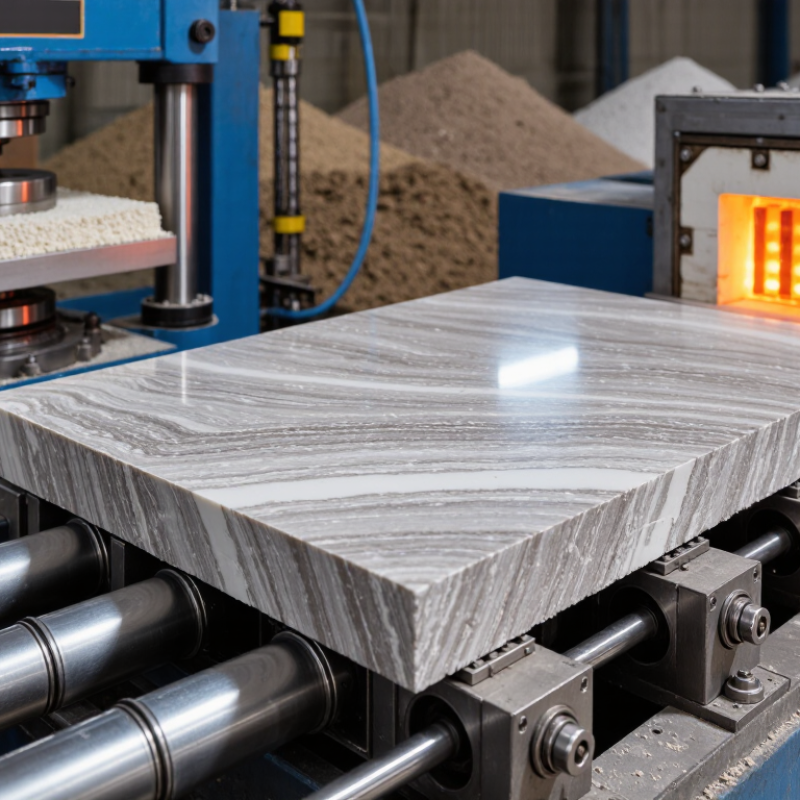
sintered stone is an engineered surface made from carefully selected minerals, pigments, and sometimes recycled raw materials. Unlike natural stone, it is manufactured under controlled industrial conditions. Producers compact the mineral blend, apply intense pressure, and fire it at very high temperatures. The result resembles a dense slab, not a simple ceramic tile.
The process begins with crushing and refining raw minerals. Large presses then remove much of the trapped air. Kilns create a heat cycle that bonds particles without adding resin-based binders. Exact temperatures and pressures vary by manufacturer. That detail matters. Technical consistency often determines strength, water absorption, colour stability, and surface performance.
Industry research supports the category’s growing relevance. Grand View Research’s engineered stone market analysis identifies residential renovation, commercial interiors, and durable worktops as major demand areas. MarketsandMarkets also reports rising interest in engineered surfaces because of their design flexibility and low-maintenance characteristics. These reports combine several product categories, however, so their figures should not be treated as precise sintered stone statistics.
Technical references add useful discipline. ISO 13006 establishes performance classifications for ceramic tiles, while the European Commission’s Best Available Techniques reference document explains energy and emissions considerations in ceramic manufacturing. Sintered stone may share similar production principles, but product claims still require independent testing.
It is not flawless.
Cutting can release fine dust, and poor installation may cause edge damage or uneven support. Buyers should check water absorption, slip resistance, thermal-shock performance, abrasion ratings, and documented test methods. This article examines what sintered stone is, how factories produce it, and where promotional language deserves closer inspection.
What Is Sintered Stone?
Sintered stone is an engineered surface made from selected minerals, such as feldspar, quartz, and natural rock particles. These materials are ground into fine powders, blended with pigments, and pressed under intense pressure. The compacted slab then enters a high-temperature kiln. Heat causes the particles to bond and form a dense, stone-like surface.
Unlike many natural stones, sintered stone is manufactured for consistent performance and appearance. Its very low porosity helps resist water, food stains, and common household chemicals. It also handles heat well, so a hot pan may be placed on the surface with proper care. The finish can resemble marble, concrete, or other stone patterns. It is not plastic laminate, and it is not simply polished granite.
The material still has limits. Large slabs can crack during transport or cutting, especially around sinks, corners, and narrow sections. A sharp impact may chip an exposed edge. Professional measuring, suitable support, and diamond cutting tools matter greatly. Regular cleaning usually needs only mild soap and water. Harsh chemicals are unnecessary. The word “sintered” is sometimes used loosely in product descriptions, so buyers should check technical data, thickness, testing standards, and warranty terms. It is highly durable, but never indestructible.
What Raw Materials Are Used to Make It?
Sintered stone begins with carefully selected mineral raw materials, not a single ingredient. Common components include feldspar, quartz or silica, kaolin clay, and other natural stone-forming minerals. Feldspar helps the mixture melt and bond during firing. Quartz contributes hardness and dimensional stability. Clay improves workability before pressing.
Small amounts of inorganic pigments create colors and surface patterns. Some manufacturers also add recycled mineral material, although the percentage depends on the production process. The raw materials are crushed, screened, and blended into a consistent powder. Water may be added temporarily to improve granulation. Then, high pressure forms the powder into large slabs.
The pressed slab enters a kiln at a very high temperature, often around 1,200°C, though exact conditions vary. Heat causes the minerals to densify and bond without relying on conventional resin binders. This is the key difference from many engineered surfaces. The final material becomes dense, low-absorption, and resistant to heat and scratching.
It sounds simple. It is not.
Mineral purity, particle size, moisture, pressure, and firing time all affect the result. A small change can influence color, warping, or strength. I would not assume that every sintered stone product has the same formula. Technical data sheets remain essential, especially when evaluating recycled content, slip resistance, or outdoor performance.
What Is Sintered Stone and How Is It Made?
Representative raw-material composition used to explain a typical sintered-stone formulation
Sintered stone is produced by compacting mineral powders and firing them under high heat and pressure. Feldspar acts as a flux, quartz and silica provide hardness, clays support forming and strength, while mineral pigments and processing additives help create color and improve manufacturing performance. Actual formulations vary according to the required color, thickness, finish, and technical properties.
How Is Sintered Stone Manufactured?
How Is Sintered Stone Manufactured?
Sintered stone begins with carefully selected natural minerals, pigments, and recycled mineral content. Manufacturers crush and blend these materials into a uniform powder. Moisture is controlled before the powder enters a powerful compaction system. Pressure removes internal gaps and creates a dense slab structure. Large-format presses may apply several thousand tonnes of force, depending on slab size and thickness.
The compacted slab is then heated in a continuous kiln, commonly above 1,200°C. The European Commission’s Ceramic Manufacturing BREF identifies firing temperatures around 1,000–1,300°C for related ceramic products. This heat bonds mineral particles without using resin as the main binder. Surface textures and patterns may be added before firing, not painted only afterward. Cutting, edge finishing, and quality inspection follow.
The process is highly controlled.
Manufacturers test water absorption, flexural strength, thermal resistance, and dimensional accuracy. ISO 13006 uses 0.5% water absorption as a benchmark for porcelain tile, although sintered stone products may follow different specifications. Grand View Research valued the global ceramic tiles market at approximately USD 227.9 billion in 2023, showing the scale of adjacent mineral-based surfaces. Still, market size does not prove every slab performs equally. Uneven heating, weak compaction, or rushed cooling can create hidden stress. Temperature alone is not quality.
What Properties Does Sintered Stone Offer?
What Is Sintered Stone and How Is It Made?
What Properties Does Sintered Stone Offer?
Sintered stone combines selected minerals under extreme pressure and controlled heat. This process creates a dense, nonporous surface with consistent performance. Independent industry test reports using ISO 10545-3 and ASTM C373 commonly record water absorption below 0.5%. That low absorption helps resist coffee, oil, and everyday moisture. Wipe marks away easily.
Its strength is practical. Reports tested under ISO 10545-4 often show flexural strength above 35 MPa, although results vary by thickness and composition. Many surfaces also reach Mohs hardness levels near 6 or 7. They tolerate scratching from cookware, tableware, and busy commercial use. Large-format slabs provide fewer joints. That can make walls and worktops appear visually calmer.
Heat resistance is another useful property. A hot pan usually causes less concern than it would on a resin-based surface. However, “heat resistant” does not mean indestructible. Sharp impacts can chip exposed edges, especially during transport or poor installation. Dark finishes may reveal fingerprints more clearly. Independent reports also show that abrasion, stain resistance, and thermal-shock results depend on the exact formulation. Check the test certificate, not only the sales description. That detail matters.