
How to Choose Mould Components in 2026?
Choosing Mould Components in 2026 requires more than comparing catalog prices. It demands a clear understanding of part geometry, production volume, resin behavior, and maintenance conditions. A component that performs well in a prototype mould may fail under continuous factory cycles. Small errors multiply. This guide examines how experienced mould designers evaluate inserts, guide systems, ejector parts, springs, cooling elements, and standard bases. It also considers surface finish, dimensional stability, corrosion resistance, and replacement access. These details often decide whether a mould remains reliable or becomes a costly interruption.
Material selection deserves careful attention. Hardened tool steel may suit abrasive materials, while corrosion-resistant grades can protect moulds exposed to moisture or aggressive additives. Tolerances should match the product, not exceed them without purpose. That choice matters. Suppliers should provide traceable specifications, inspection records, and consistent delivery support. In 2026, digital part libraries and simulation tools can improve selection, but they cannot replace practical validation. Real moulds still reveal trapped air, uneven cooling, burr formation, and difficult ejection. No selection guide is flawless. Designers must question assumptions, review failure history, and test critical Mould Components before full production. A cheaper component may reduce the purchase cost, yet increase polishing time or downtime later. Conversely, premium parts are not automatically suitable. The best decision balances performance, serviceability, safety, sustainability, and total ownership cost. Careful documentation makes that decision repeatable. It also helps teams explain why a component was chosen when conditions change.
Mould Components: Their Roles and Classification
How to Choose Mould Components in 2026?
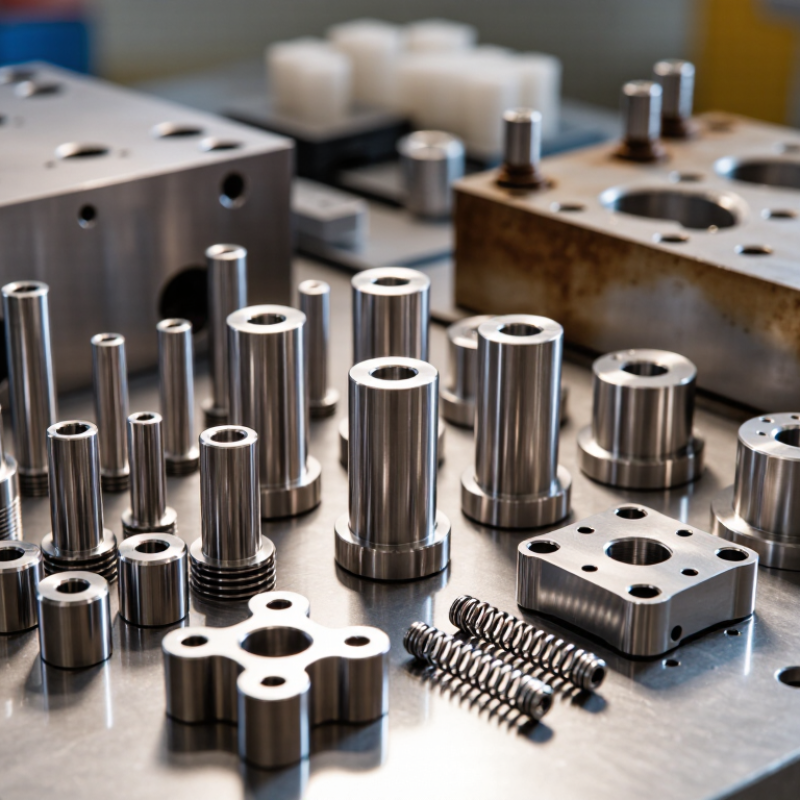
Mould components are the working system behind stable, repeatable production. Their roles determine how a mould opens, fills, cools, and releases parts. I have seen small component errors create flash, uneven surfaces, and difficult maintenance. Small parts matter. A component that looks interchangeable may alter alignment or cycle time.
Classification makes selection clearer. Structural components include mould plates, bases, and support pillars. Guiding components, such as guide pins and bushes, control accurate mould movement.
Cavity and core inserts shape the product and require suitable hardness, surface finish, and dimensional stability. Ejection components push the finished part away without damaging delicate edges.
Runner and gating parts manage material flow, while cooling components control heat near the cavity. Each group has a different responsibility.
In 2026, selection should combine part geometry, production volume, material temperature, and maintenance access.
Check load data, tolerance requirements, corrosion risks, and expected thermal cycles before ordering. For high-cycle moulds, hardened working surfaces may reduce replacement frequency. However, excessive hardness can make repair more difficult.
I once treated cooling layout as a secondary issue; that decision caused longer cycles and visible warpage. The lesson still needs refinement. Cooling channels, seals, and connectors deserve the same attention as visible mould parts. Reliable choices come from drawings, measured samples, supplier specifications, and production records, not assumptions.
Key Factors for Selecting Mould Components in 2026
How to Choose Mould Components in 2026?
Selecting mould components in 2026 requires more than comparing prices. Start with the mould’s material, production volume, dimensional tolerance, and expected cycle count. Hardened guide pins and bushes suit high-volume moulds better than basic soft-steel options. Ejector pins must match the resin, wall thickness, and ejection force. Small mismatches can create scratches, bending, or premature failure.
Component compatibility matters. Check the steel grade, hardness, coating, heat resistance, and operating temperature. Cooling fittings should support stable water flow without restricting maintenance access. Inserts need accurate alignment and enough strength around thin sections. I have seen a well-machined mould fail because its ejector system lacked proper support. The machining was not the real problem.
Not every advanced component improves production. Digital monitoring can help track wear, but only when technicians review the data regularly. Request clear drawings, material certificates, tolerance data, and test records from qualified suppliers. Confirm replacement availability before approving the design. A component that performs well in a laboratory may behave differently under dust, heat, and continuous cycling. Leave realistic clearance for thermal expansion. This detail is easy to overlook. I still review it twice. Feedback from operators can reveal vibration, sticking, or maintenance problems that drawings never show. When selecting parts, balance precision, service life, safety, and practical repair needs.
How to Match Components with Mould Design Requirements
Choosing mould components in 2026 starts with the part, not a catalogue. Match each component to the mould design, material, cycle time, and maintenance plan. A thin rib may need precise support and careful venting. A deep cavity may demand stronger guidance and controlled cooling. These details affect production stability and defect rates. Keep it practical.
Check the mould material, expected pressure, and production volume before selecting inserts, guide elements, ejectors, and seals. For abrasive resins, hardened wear surfaces can extend service life. For high-temperature processing, confirm thermal stability and clearance changes. Ejector pins should remove the part evenly without leaving marks. Their layout must follow the parting line and draft angles. A good component can still fail when cleaning access is ignored.
Experienced toolmakers also inspect cooling channels near component locations. A guide pin placed too close to a channel may weaken the plate. It may also complicate drilling. Use load calculations, technical data, and trial results rather than habit alone. Record alignment, wear, torque, and cycle performance during testing. Not every design decision will be perfect. I have seen one small clearance assumption create weeks of adjustment. That mistake matters only when documented and corrected. Include inspection points, replaceable wear parts, and measurable shut-off surfaces. Reliable matching comes from evidence, not guesswork.
How to Choose Mould Components in 2026? — Matching Components with Mould Design Requirements
Typical hardness ranges help screen mould-component materials according to wear, corrosion, temperature and production-volume requirements. Use the chart as an initial selection guide, then confirm toughness, heat treatment, dimensional tolerance and actual moulding conditions.
Selection logic: Pre-hardened steels such as 1.2311 are suitable for general mould bases and medium-volume production. Corrosion-resistant 1.2316 is commonly selected for humid environments or corrosive plastics. Hot-work steel 1.2344 supports elevated thermal loads, while wear-resistant grades such as 1.2379 and 1.3343 are better suited to inserts, shut-offs and high-abrasion applications. The hardness values shown are typical reference ranges and may vary with heat treatment and supplier specification.
Material, Precision, Durability, and Cost Considerations
How to Choose Mould Components in 2026?
In 2026, mould component selection should begin with working conditions, not catalogue price. Experienced toolmakers check resin temperature, injection pressure, cycle count, and maintenance access. Hardened tool steel suits abrasive materials and repeated production. Corrosion-resistant steel helps with moisture or chemically active resins. Softer materials may reduce machining costs, but they can wear quickly around gates, slides, and ejector holes. That choice affects dimensional stability. It also affects downtime.
Precision requires more than a tight tolerance on paper. Measure fit, surface finish, alignment, and thermal movement together. A guide pin with excellent roundness can still fail if its bushing seat is misaligned. Ask suppliers for inspection records, hardness results, and traceable material certificates. In production, monitor flash, burrs, uneven wear, and ejection marks. These details reveal actual performance. I once selected a cheaper ejector set for a short-run mould. It worked initially, but polishing and replacement erased the savings. The lesson is uncomfortable: the lowest purchase price can become the highest operating cost.
Tips: Match hardness to wear risk, not habit. Reserve ultra-tight tolerances for functional surfaces. Calculate cost per cycle, including lubrication, replacement, and lost production. Keep spare pins and springs for critical areas. Document actual service life; estimates are often optimistic.
| Component Material | Typical Hardness | Thermal Conductivity | Corrosion Resistance | Typical Machining Tolerance | Expected Tooling Life | Relative Cost Index | Recommended Applications |
|---|---|---|---|---|---|---|---|
| P20 Pre-Hardened Tool Steel | 28–34 HRC | Approximately 29–34 W/m·K | Low; requires protection against moisture and corrosive resins | Approximately ±0.02–0.05 mm, depending on component size and process | About 100,000–300,000 cycles with suitable maintenance | 1.0 | General-purpose mould bases, plates, holders, and medium-volume injection moulds |
| H13 Hot-Work Tool Steel | 44–52 HRC after heat treatment | Approximately 24–28 W/m·K | Low to moderate; surface treatment is often beneficial | Approximately ±0.01–0.03 mm after precision machining | About 300,000–1,000,000 cycles, depending on load and maintenance | 1.8 | High-temperature mould inserts, die-casting components, and high-wear applications |
| 420 Stainless Tool Steel | 48–52 HRC after heat treatment | Approximately 24–30 W/m·K | Good when properly heat-treated, polished, and maintained | Approximately ±0.01–0.03 mm after precision machining | About 300,000–1,000,000 cycles for suitable moulding conditions | 2.2 | Optical parts, medical components, food-contact tooling, and corrosive resin applications |
| S136-Type Stainless Tool Steel | 45–52 HRC after heat treatment | Approximately 24–30 W/m·K | Very good after polishing and correct heat treatment | Approximately ±0.01–0.02 mm for precision inserts | About 500,000–1,000,000 cycles in demanding moulding environments | 2.5 | High-gloss optical surfaces, medical moulds, PVC processing, and corrosive plastics |
| 718-Type Pre-Hardened Tool Steel | 33–38 HRC | Approximately 29–34 W/m·K | Low; protective coating or regular maintenance may be required | Approximately ±0.01–0.03 mm after precision machining | About 200,000–500,000 cycles for general injection moulding | 1.4 | Medium-volume mould inserts, automotive interior parts, and general precision components |
| Aluminium Alloy 7075-T6 | Approximately 150–180 HB | Approximately 130–170 W/m·K | Moderate; anodizing or coating improves protection | Approximately ±0.02–0.05 mm, depending on geometry and thermal stability | About 10,000–100,000 cycles, depending on resin, pressure, and surface treatment | 0.8 | Prototype moulds, short production runs, rapid cooling, and lightweight tooling |
| Copper Alloy Insert | Approximately 80–220 HB, depending on alloy and treatment | Approximately 100–300 W/m·K | Good in normal moulding environments; alloy selection is important | Approximately ±0.02–0.05 mm because of lower hardness and wear sensitivity | About 20,000–200,000 cycles, depending on hardness and abrasive content | 2.0–3.5 | Local cooling inserts, hot-spot control, thin-wall parts, and difficult-to-cool regions |
| Carbide Wear Insert | Approximately 70–92 HRA | Approximately 50–100 W/m·K, depending on grade | Good in most moulding environments | Approximately ±0.005–0.02 mm with precision grinding | Often above 1,000,000 cycles in high-wear locations | 4.0–8.0 | Gate areas, shut-offs, sliding wear surfaces, abrasive glass-filled resins, and replaceable wear parts |
| Data interpretation: Values are typical engineering ranges rather than guaranteed specifications. Actual performance depends on steel grade, heat treatment, polishing, coating, mould design, resin type, glass-fibre content, injection pressure, cooling conditions, alignment, lubrication, and preventive maintenance. The relative cost index uses P20 pre-hardened tool steel as the baseline value of 1.0; it is intended for early-stage comparison, not as a quoted market price. | |||||||
Emerging Technologies Shaping Mould Component Selection
How to Choose Mould Components in 2026?
Emerging technologies are changing how engineers select mould components.
Artificial intelligence can compare cycle times, pressure data, material behaviour, and maintenance records. It helps teams identify suitable cooling systems, ejector pins, sensors, and flow-control parts. However, an algorithm is only as reliable as its input data. Poor historical records can produce confident but unsuitable recommendations.
Digital twins now allow engineers to test mould performance before machining begins.
A virtual model can show uneven cooling around a thick rib or stress near an ejector hole. This makes component selection more practical and less dependent on guesswork. In real production reviews, sensor-ready components also provide useful temperature and pressure data during trials. Small changes can reveal major problems.
Additive manufacturing is expanding design options for conformal cooling inserts.
These inserts may shorten cooling cycles and reduce warpage in complex parts. Material selection still matters. Heat resistance, surface hardness, and repair options must match the production environment. Sustainable manufacturing is also influencing decisions, especially when components support recycled polymers or lower-energy processing.
Not every new technology deserves immediate adoption.
I have seen advanced monitoring plans fail because operators lacked time to read the data. That lesson remains important. Choose components that fit the mould, the material, and the people using them.
Reliability often begins with a simple question: Can the team maintain it correctly?
Article Source:
Ready to talk about water treatment?
Contact us
Please complete this form and we will be in touch